Barnacle Goose

Painting by Missy Dunaway. Created with acrylic ink on paper. 30x22 inches (76x56 cm)
Painting Key
Fauna: 2 Barnacle geese (Branta leucopsis), gooseneck barnacles (Pollicipes pollicipes)
Flora: Driftwood, willow
Objects: 5 Barnacle goose eggs, 8 barnacle goose feathers
Plants mentioned by Shakespeare: Willow (Salix caprea)
Shakespeare’s Barnacle Goose
Occurrences in text: 1
Plays: The Tempest
Name as it appears in the text: “barnacles”
CALIBAN: I will have none on ’t. We shall lose our time
And all be turned to barnacles or to apes
With foreheads villainous low.The Tempest (Act 4, Scene 1, line 274)
For seventeenth-century audiences, the barnacle goose was a symbol of metamorphosis. Its unusual name reflected the early modern belief that it hatched from barnacles, making it part fish. Shakespeare mentions the bird only once, in The Tempest. On the island where the play unfolds, Caliban—himself the son of a sea witch and believed to be part fish—warns the stranded Stephano and Trinculo to flee before the powerful magician Prospero discovers them and transforms them "to barnacles, or to apes."
The barnacle goose appears in The Tempest. Illustration by H. L. Ford (1709). Folger Shakespeare Library.
Barnacle geese breed and raise their young in remote Arctic regions, and their reproductive processes were mysterious during the medieval period. Each year, the geese flew south, descending upon northern Scotland, Ireland, and the British Isles, inspiring a range of ideas about their repopulation. Some sixteenth-century naturalists proposed that the geese began their lives as downy buds of the willow tree, endowing the bird with its alternative name, "tree goose." [1]

An illustration of the “tree geese” found in the margins of Topographia Hibernia by Gerald of Wales, c 1196-1223. British Library, Royal MS 13 B VIII.
Another explanation was offered by the Italian mathematician Gerolamo Cardano, who argued that the birds dropped their eggs into the ocean, where the waves whisked them into seafoam that turned into barnacles, then geese. [2] The English herbalist John Gerard speculated that barnacle geese were born from driftwood that originated from shipwrecks. (How fitting that the species appears in The Tempest, a play that begins with a shipwreck.) According to Gerard, rotten driftwood would "breedeth" into small, mussel-like crustaceans, gooseneck barnacles, which then developed into goslings. [3]
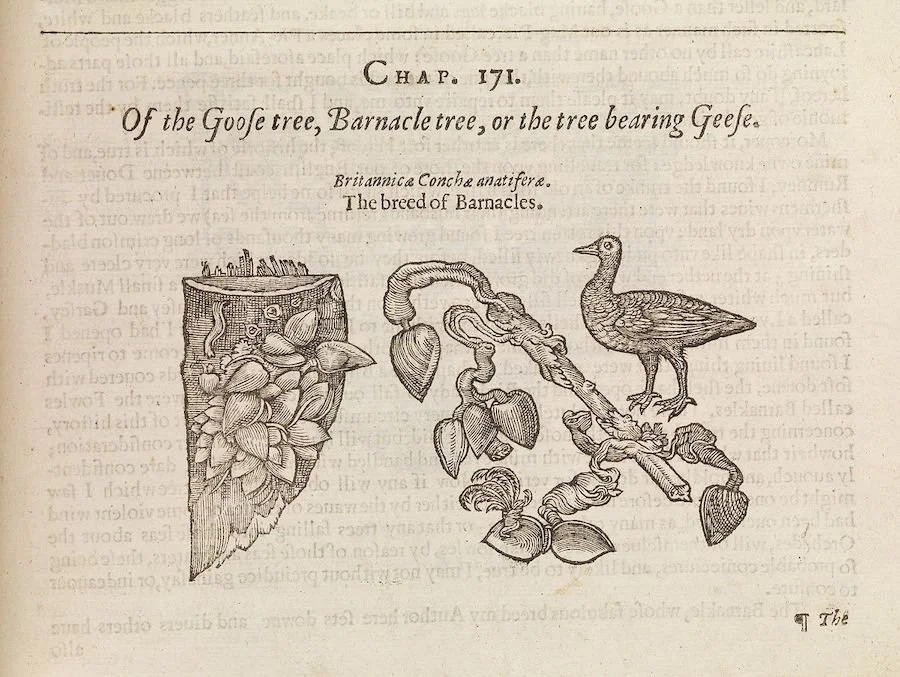
John Gerard’s illustration depicting the reproductive lineage of the “tree goose” in The Generall Historie of Plantes (1597). Kinney Center for Interidisciplinary Renaissance Studies.
If we accept the lateral logic of the early modern era, we can appreciate why naturalists connected these two unlikely creatures. Gooseneck barnacles cluster by the thousands, tethered to the rocky coastlines of northern England and Scotland, inhabiting the same geographic location and coastal habitat as their avian counterparts. The barnacle also has a distinctive goose-like neck, or peduncle, that allows the rock-bound crustacean to float with the tides, suspended in water. A fibrous, feather-like arm draws in debris and plankton for food. The base of the peduncle, where it meets the shell, has a black and white scalloped pattern that is not so different from the patterning displayed on the goose’s breasts and flanks. The myth of the barnacle goose as a combination of species was well enough accepted that the fowl was considered a proper meal during Lent because it was part fish and not born from flesh. [4]
Endnotes
[1] Harting, J., The Birds of Shakespeare, (London: John Van Voorst, Paternoster Row, 1871), 247-256.
[2] Buckeridge, J., and Watts, R., "Illuminating our World: An Essay on the Unraveling of the Species Problem, with Assistance from a Barnacle and a Goose," Humanities, Earth & Oceanic Systems Group, RMIT University, Melbourne, October 15, 2012.
[3] Gerard, J. Gerard’s Herbal. Studio Editions Ltd. (Guernsey: The Guernsey Press Co Ltd., 1994), Pg. 283-284.
[4] Greenoak, F., All The Birds of the Air, 2nd ed, (Middlesex: Penguin Books Ltd., 1981), 68-69.