Common Kingfisher (Alcedo atthis)
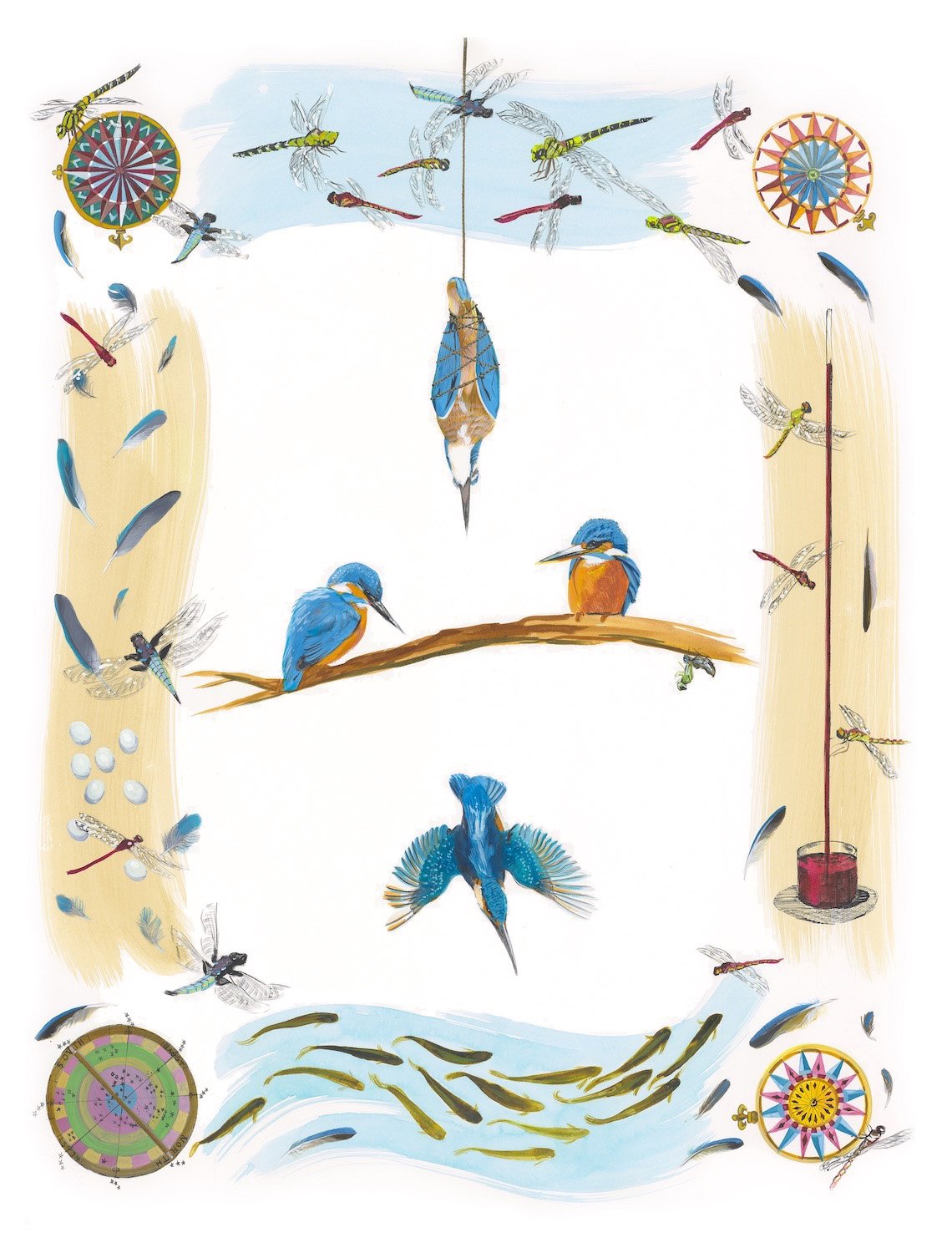
Painting by Missy Dunaway. Created with acrylic ink on paper. 30x22 inches (76x56 cm)
Painting Key
Fauna: 4 Common kingfishers (Alcedo atthis), prey: 16 minnows, broad-bodied chaser dragonfly, common darter dragonfly, four-spotted chaser dragonfly, southern hawker dragonfly
Objects: barometer invented by Evangelista Torricelli (1643), 4 compasses from The Mariner’s Mirrour (1588), 8 common kingfisher eggs, 23 common kingfisher feathers
Shakespeare’s Kingfisher
Occurrences in text: 2
Plays: Henry VI Part 1, King Lear
Name as it appears in text: “halcyon”
The common kingfisher is referred to by Shakespeare as a “halcyon.” It is a brilliant blue and orange bird the size of a billiard ball with a prominent, sharp beak. If seen in the wild, the speedy kingfisher is usually visible as a blue streak of light diving into still water. In All The Birds of the Air, Francesca Greenoak muses that it merits the name ‘kingfisher’ because it is the king of fishing birds and it has royal colored plumage.[1]
The kingfisher needs to see its prey from perches above the surface, so sunny conditions and placid waters offer the best hunting conditions. For this reason, they are most active during calm weather, which inspired a theory that the bird itself attracted a favorable climate.[2]
This belief mirrors a Greek myth that Poseidon kept the waters still for seven days in winter as a courtesy to two nesting kingfishers—the Thessalian princess, Alcyone, and her husband, Ceyx. These two doomed lovers drowned at sea but were resurrected and transformed into seabirds (presumably kingfishers) by the merciful gods who admired their love and devotion.[3] In 1 Henry VI, Joan of Arc references to peaceful “halcyon days” when the kingfisher is nesting on riverbanks:
1 Henry VI (Act I, Scene 2, Line 132)
PUCELLE: Assigned am I to be the English scourge.
This night the siege assuredly I’ll raise.
Expect Saint Martin’s summer, halcyons’ days,
Since I have enterèd into these wars.

One of the few kingfisher references is given to the character of Joan of Arc, an antagonist in 1 Henry VI. Joan de Pucelle promises to bring peaceful “halcyon days” to France. Illustration by Edward Corbould, Henry Cook (1837). Folger Shakespeare Library
Subsequent myths built upon this legend by attributing even more elemental powers to the kingfisher. Like a rabbit’s foot, a dead and dried kingfisher was a lucky charm that served multiple purposes. The Greeks believed a dried kingfisher would ward off Zeus's lightning.[4] Giraldus Cambrensis, also called Gerald of Wales, was a twelfth-century archdeacon and historian who stated that a dead kingfisher's plumage would change throughout the year and revive in the spring, like the leaves of a tree. [5] He also suggested they were handy charms to store inside closets to perfume clothes and repel moths:
It is remarkable in these little birds that, if they are preserved in a dry place, when dead, they never decay; and if they are put among clothes and other articles, they preserve them from the moth and give them a pleasant odour. What is still more wonderful, if, when dead, they are hung up by their beaks in a dry situation, they change their plumage every year, as if they are restored to life. (Topography of Ireland, 1187)[6]
Shakespeare’s dried kingfisher serves another purpose that incorporates its fabled relationship to sea winds. If dangling from the end of a string like a plumb, it was believed a dead kingfisher’s beak would point in the direction of the wind like a weathervane.[7]
King Lear (Act II, Scene 2, Line 80)
KENT: That in the natures of their lords rebel—
Being oil to fire, snow to the colder moods—
<Renege,> affirm, and turn their halcyon beaks
With every <gale> and vary of their masters,
Knowing naught, like dogs, but following.—
In my painting, a dead kingfisher hangs from a string. I have included a compass rose in each corner of the composition to imply its use as a weathervane. I try to choose objects from Shakespeare’s lifetime (or as close as possible), so the compass designs are borrowed from The Mariner’s Mirrour, a collection of English nautical maps from 1588.[8] The earliest model of the barometer is on the right, which was invented by the Italian physicist Evangelista Torricelli in 1643.[9] The high level of mercury in the barometer’s shaft indicates favorable weather conditions.
Below the dangling kingfisher are three live companions poised to hunt sixteen minnows— the average number of fish a common kingfisher eats in a day.[10] Dragonflies, which dance around the kingfishers, are another favorite food source.[11]
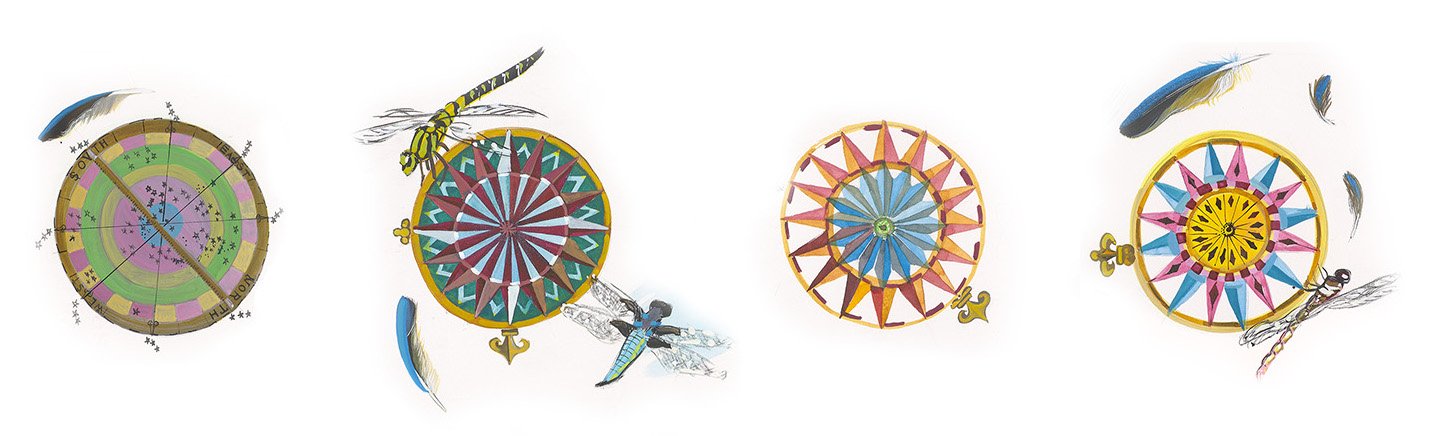
The compass rose designs included in my painting are borrowed from The Mariner’s Mirrour, a collection of English nautical maps from 1588. British Library Board, Creative Commons[12]
Endnotes
[1] Greenoak, F., All The Birds of the Air, 2nd ed, (Middlesex: Penguin Books Ltd., 1981), 179.
[2] Harting, J., The Birds of Shakespeare, (London: John Van Voorst, Paternoster Row, 1871), 275.
[3] Greenoak, F., All The Birds of the Air, 2nd ed, (Middlesex: Penguin Books Ltd., 1981), 179.
[4] Greenoak, F., All The Birds of the Air, 2nd ed, (Middlesex: Penguin Books Ltd., 1981), 179.
[5] Cambrensis, Giraldus. Topography of Ireland, 1187, ed. Wright, 1813, p. 39.
[6] Cambrensis, Giraldus. Topography of Ireland, 1187, ed. Wright, 1813, p. 39.
[7] Harting, J., The Birds of Shakespeare, (London: John Van Voorst, Paternoster Row, 1871), 275.
[8] Ashley, A. Sir., Waghenaer, L., The Mariner’s Mirrour, 1588. (London: H. Hasselup. British Library Board, Creative Commons).
[9] Turgeon, A.,, “Resource Library | Encyclopedic Entry: Barometer,” National Geographic, June 19, 2014, https://www.nationalgeographic.org/encyclopedia/barometer/. Accessed September 3 2021.
[10] “Common Kingfisher: Breeding, feeding and territory.” The Royal Society for the Protection of Birds, https://www.rspb.org.uk/birds-and-wildlife/wildlife-guides/bird-a-z/kingfisher/breeding-feeding-territory/. Accessed August 4 2022.
[11] “Common Kingfisher: Breeding, feeding and territory.” The Royal Society for the Protection of Birds, https://www.rspb.org.uk/birds-and-wildlife/wildlife-guides/bird-a-z/kingfisher/breeding-feeding-territory/. Accessed August 4 2022.
[12] Ashley, A. Sir., Waghenaer, L., The Mariner’s Mirrour, 1588. (London: H. Hasselup. British Library Board, Creative Commons).