Ostrich (Struthio camelus)
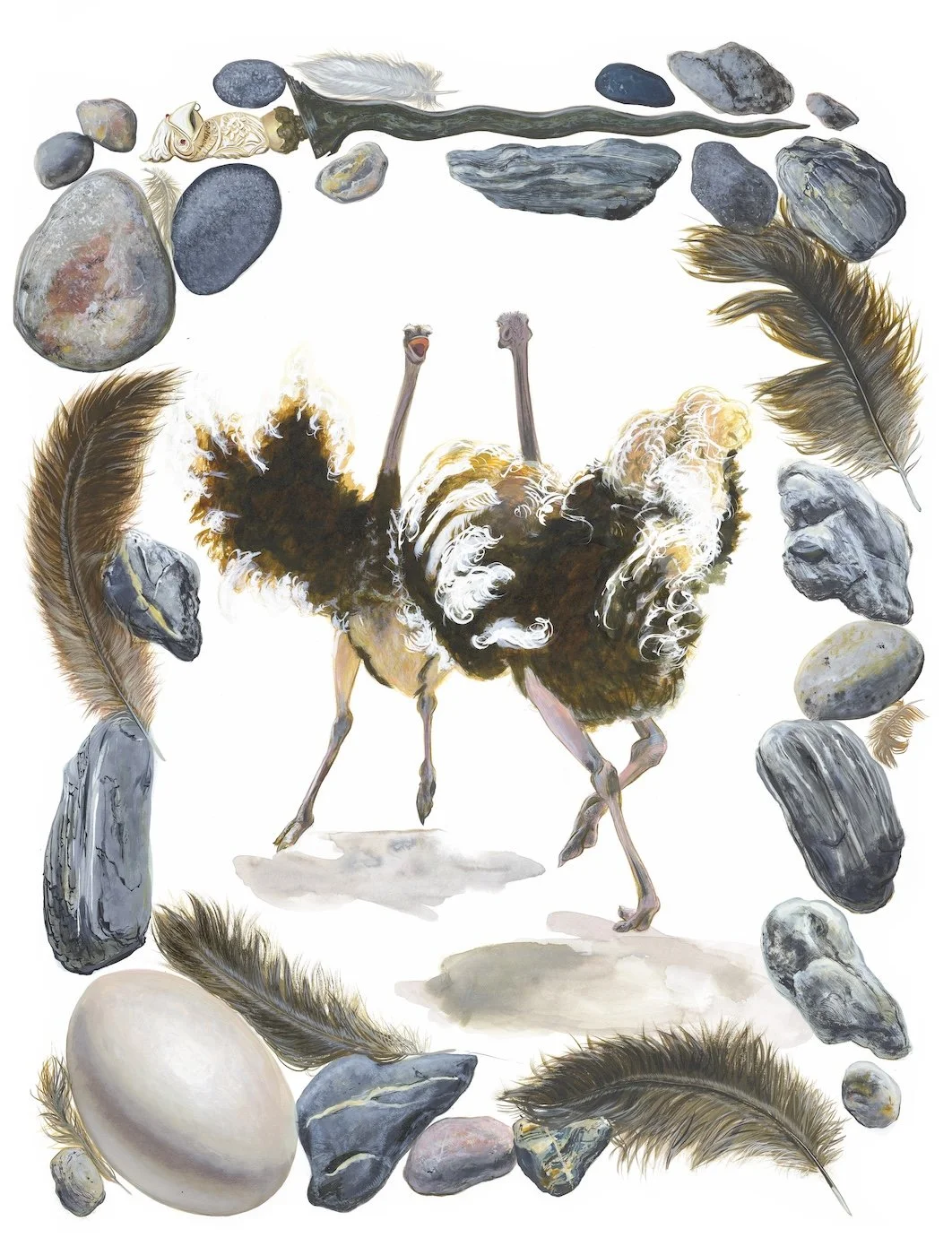
Ostrich (Struthio camelus) by Missy Dunaway, 30x22 inches, acrylic ink on paper
Painting Key
Fauna: 2 male ostriches (Struthio camelus)
Objects: 8 ostrich feathers, 1 ostrich egg, 23 rocks, 1 dagger
Shakespeare’s Ostrich
Occurrences in text: 6
Plays: Henry IV Part 1, Henry VI Part 2
Name as it appears in the text: “ostrich,” “estridge,” “ostridge”
Among Shakespeare’s birds, the ostrich is one of the strangest. Unlike the easily observed robin, lark, or crow, the ostrich’s reputation in early modern England was assembled from Greek legend, biblical references, and travelers’ tales. The ostrich's folklore, which influenced Shakespeare, embodies many contradictions: powerful yet foolish, maternal yet neglectful.
Going back to the earliest written records of the ostrich, its identity has always seemed uncertain. Ancient writers called it the camel-bird, suggesting ambiguity about where it belonged in the natural order.[1] The earliest recorded use of ostrich in English dates to around 1200 and referred to an eastern kingdom or country.[2] This may have inspired the word's later application to the earth's largest bird, native to Africa and the Middle East. The earliest known use of ostrich in this sense appears around 1250 in Ancrene Riwle, a Middle English guide for anchoresses, or female religious recluses.[3]
Roman Roots
If the bird originated in Africa and the Middle East, how did religious recluses in medieval England know about it, let alone Shakespeare and his early modern audiences? It's possible that the ostrich's reputation spread because it was so well-loved by the far-reaching and influential Romans. Ostriches appear frequently in Roman mosaics and decorative arts, depicted being led by reins, pulling carriages, ridden by soldiers, or foraging among other animals.
Notably, the ostrich caught the attention of Pliny the Elder (AD 23 - 79), the Roman author, naturalist, scientist, and military commander of the early Roman Empire. Pliny authored one of the earliest encyclopedic works of natural history. The collection of thirty-seven books, divided into ten volumes, attempted to catalog the full breadth of Roman knowledge. It is here that we encounter the earliest record of the myth that ostriches hide their heads in the sand, which he describes in the first chapter of Book 10, entitled, "The Natural History of Birds":
The history of the birds follows next, the very largest of which, and indeed almost approaching to the nature of quadrupeds, is the ostrich of Africa or Æthiopia. This bird exceeds in height a man sitting on horseback, and can surpass him in swiftness, as wings have been given to aid it in running; in other respects ostriches cannot be considered as birds, and do not raise themselves from the earth. They have cloven talons, very similar to the hoof of the stag; with these they fight, and they also employ them in seizing stones for the purpose of throwing at those who pursue them. They have the marvellous property of being able to digest every substance without distinction, but their stupidity is no less remarkable; for although the rest of their body is so large, they imagine, when they have thrust their head and neck into a bush, that the whole of the body is concealed. Their eggs are prized on account of their large size, and are employed as vessels for certain purposes, while the feathers of the wing and tail are used as ornaments for the crest and helmet of the warrior.[4]
This passage is also the source of a myth that Shakespeare repeats: that the ostrich can swallow and digest anything, including stones and iron. This image is evoked in a threat of violence delivered by the riotous rebel leader, Jack Cade, in Henry VI Part 2. Cade, on the run and in hiding, prepares to attack a landowner who has come upon him, assuming he will be turned in for a reward:
Henry VI, Part 2, Act IV, Scene 10, Line 25
CADE, aside: Here’s the lord of the soil come to seize
me for a stray, for entering his fee-simple without
leave.—Ah, villain, thou wilt betray me and get a
thousand crowns of the King by carrying my head
to him; but I’ll make thee eat iron like an ostrich
and swallow my sword like a great pin, ere thou
and I part.He draws his sword.
The myth of the iron-eating ostrich is less known today, yet it has endured for centuries. It appears in works ranging from John Marston’s Certaine Satyres in Metamorphosis of Pigmalions (1598) to Thomas Wall’s Comment on the Times (1657). We even see the myth repeated in Herman Melville’s Moby-Dick; or The Whale (1851):
He bolts down all events, all creeds, and beliefs, and persuasions, all hard things visible and invisible, never mind how knobby; as an ostrich of potent digestion gobbles down bullets and gun flints. And as for small difficulties and worryings, prospects of sudden disaster, peril of life and limb; all these, and death itself, seem to him only sly, good-natured hits, and jolly punches in the side bestowed by the unseen and unaccountable old joker.[5]
While exaggerated, the idea of an ostrich eating iron stems from a real avian behavior. Many birds, including ostriches, lack teeth and swallow their food whole. They will intentionally consume stones and pebbles to grind their food in the gizzard, beginning the digestive process.
The Ostrich in Art: Carved Eggs, Fashionable Feathers, Family Crests
While searching for pictorial depictions of ostriches in early modern books and manuscripts, I found far more representations of their eggs and feathers than of the birds themselves. The ostrich lays the largest egg in the world. Across cultures, ostrich eggs were carved, painted, mounted, and transformed into ceremonial vessels. In medieval and early modern Europe, they also became symbols of the Immaculate Conception of the Virgin Mary.[6]
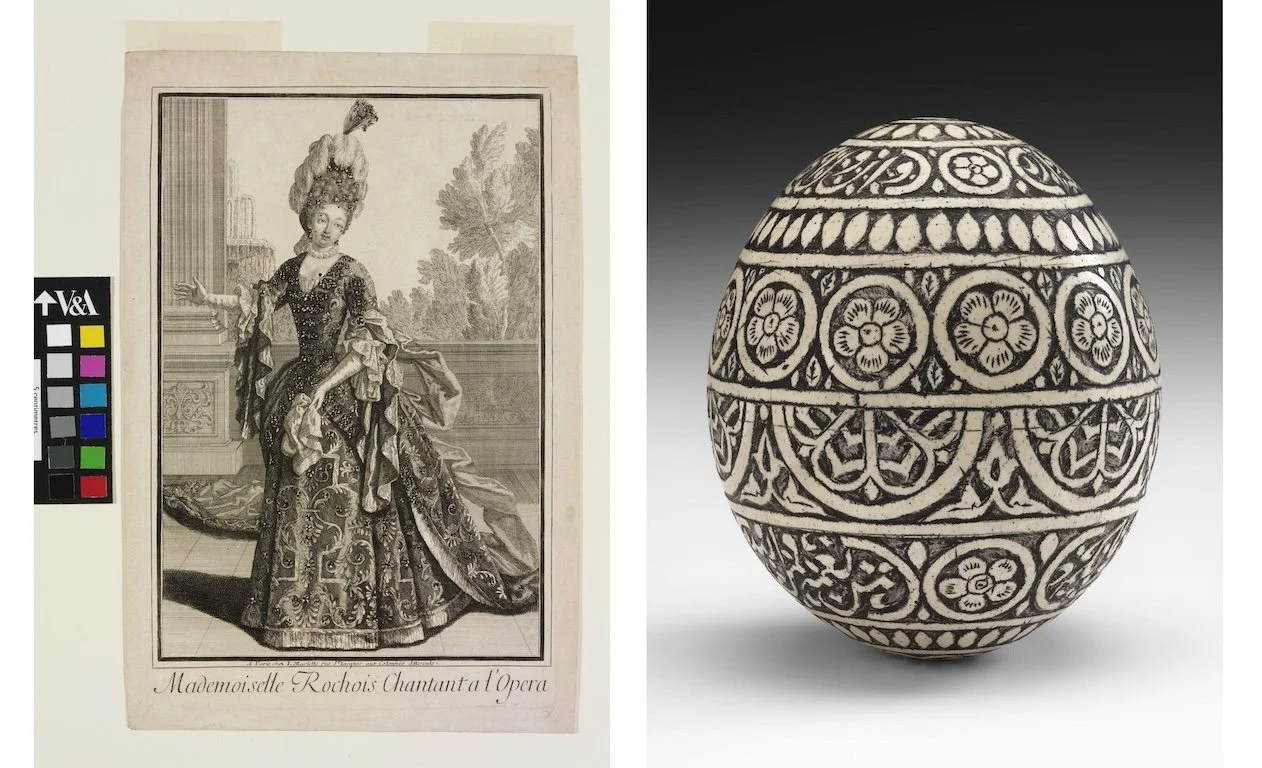
Ostrich feathers and eggs have inspired art and fashion around the world for centuries. On the left, Mademoiselle Julie Maupain wears a hat adorned with white ostrich feathers (print made late 17th century-early 18th century). On the right, a carved ostrich egg from Syria, made between 1750 and 1799.
© Victoria and Albert Museum, London. Used under V&A Explore the Collections terms.
The white plumage of the male ostrich likewise became associated with status and display. Ostrich feathers adorned aristocratic dress, royal garments, crowns, and jewelry. Shakespeare references this fashion in Henry IV, Part 1, using the variant spelling “estridge.” Vernon describes Prince Hal and his comrades preparing for battle in magnificent dress, “all plumed like estridges.” The image emphasizes their splendor, but it irritates Hal’s rival, Hotspur, who is frustrated by the idealized portrayal of his enemy.
Henry IV Part 1, Act IV, Scene 1, Line 99
HOTSPUR: He shall be welcome too. Where is his son,
The nimble-footed madcap Prince of Wales,
And his comrades, that daffed the world aside
And bid it pass?VERNON: All furnished, all in arms,
All plumed like estridges that with the wind
Bated like eagles having lately bathed,
Glittering in golden coats like images,
As full of spirit as the month of May,
And gorgeous as the sun at midsummer,
Wanton as youthful goats, wild as young bulls.
[…]HOTSPUR: No more, no more! Worse than the sun in March
This praise doth nourish agues. Let them come.
Among all the illustrations of eggs and feathers I found, there was one drawing of the bird that kept resurfacing in a noteworthy coat of arms: the family crest of John Smith. It might seem like a far leap to describe John Smith in an essay about Shakespeare, but their lifetimes overlapped. They were just 15 years apart in age, and both men died at fifty-two years old.
John Smith had a career as a mercenary before establishing Jamestown, meeting Pocahontas, and exploring and mapping the Chesapeake Bay for British colonists. Before his involvement in North America, he served as a soldier in various European conflicts, a background that later contributed to his reputation as an adventurous, swashbuckling figure. Some later accounts of his life, including claims of dramatic battlefield exploits and his capture and escape from Ottoman captivity, are debated by historians.[7] An ostrich eating a horseshoe, which symbolized strength through resilience in the face of hardship, is at the top of Smith's family crest.
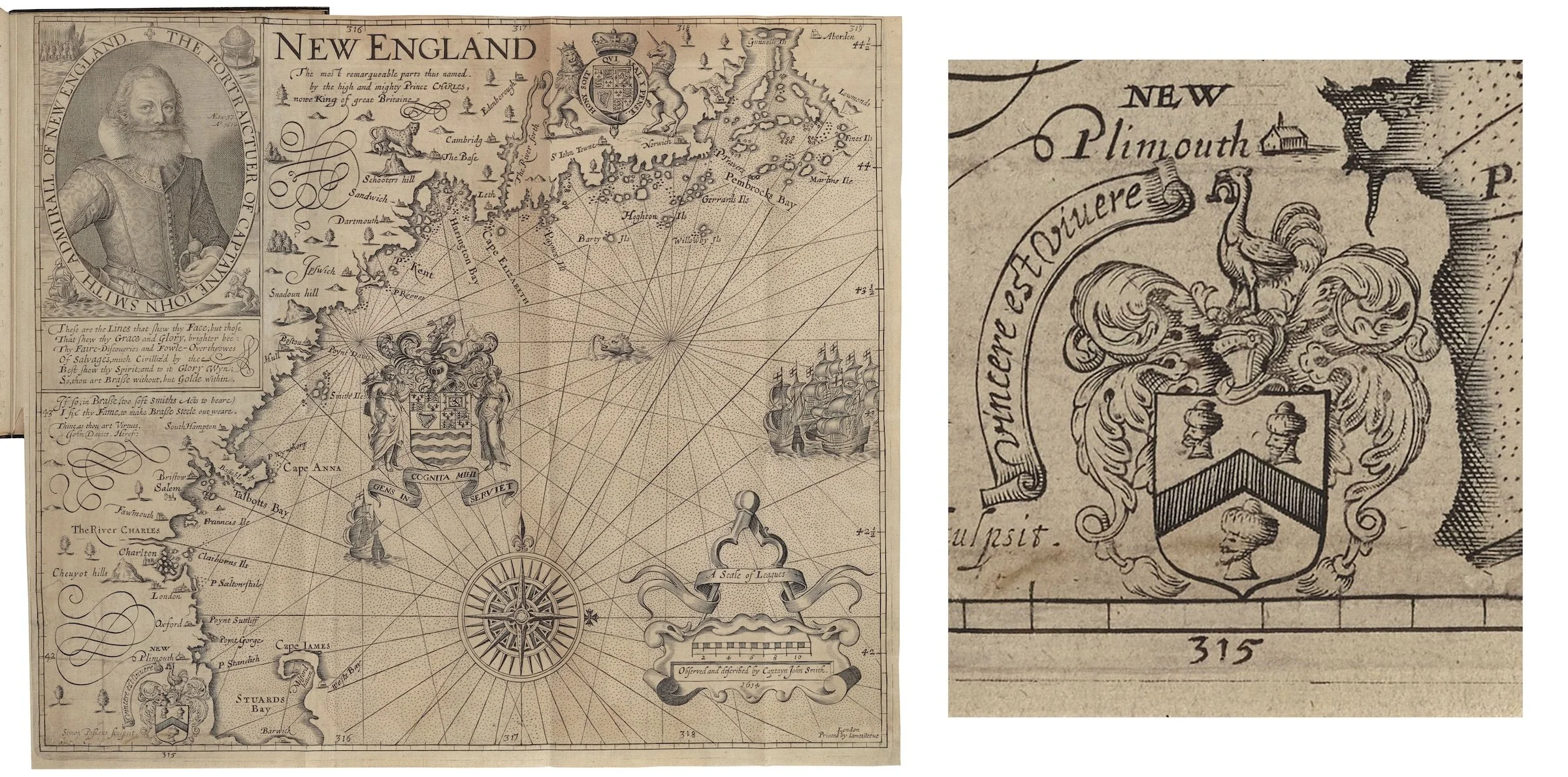
A map of New England authored by John Smith and printed by Simon van de Pass in 1631. Smith’s family crest, which includes an ostrich eating a horseshoe, is visible at the bottom left corner of the map. Detail on right. Folger Shakespeare Library
The Mother Ostrich
Given the ostrich’s magnificent eggs and the art they inspired, it is no surprise that the bird’s reproductive habits became a subject of fascination. Early accounts imagined the ostrich as both an ideal mother and a negligent one. One legend claimed that the female did not sit on her eggs but warmed them from a distance through her loving gaze.[8]
Another story recorded by the geographer Leo Africanus (1494 - 1554) described a less flattering interpretation: that the ostrich possessed such a poor memory that she would forget where she had laid her eggs and abandon them on the bare sand, leaving another female to discover and raise them as her own.[9] The forgetful ostrich who wanders away from her eggs also appears in the King James Bible from 1611:
Gavest thou the goodly wings unto the peacocks? or wings and feathers unto the ostrich?
Which leaveth her eggs in the earth, and warmeth them in dust,
And forgetteth that the foot may crush them, or that the wild beast may break them.
She is hardened against her young ones, as though they were not hers: her labour is in vain without fear;
Because God hath deprived her of wisdom, neither hath he imparted to her understanding.[10]
This legend is actually very close to the ostrich’s true mating behavior. Ostriches lay their eggs in a shallow depression in the sand prepared by a male ostrich, who mates with some, if not all, of the females in his herd. These communal nests may reach nine feet in diameter and hold an average of twenty eggs laid by several females.[11] Although many hens contribute eggs, only the dominant hen and the male incubate the clutch. Upon hatching, the young are self-sufficient and able to feed themselves.[12]
The theme of avian mothers reminds us of another legendary bird: the pelican, which was believed to pierce its own breast to feed its chicks with its blood. In Aesop’s fable, "The Ostrich and the Pelican," the two birds debate their opposing approaches to motherhood. The ostrich mocks the pelican for injuring herself to nourish her chicks, defending her own method of laying eggs in the sand and trusting the chicks to take care of themselves. The pelican delivers the moral of the story, assuring the ostrich that the temporary pain of caring for newly hatched chicks is outweighed by the love and joy of parenthood.
Behind the Painting
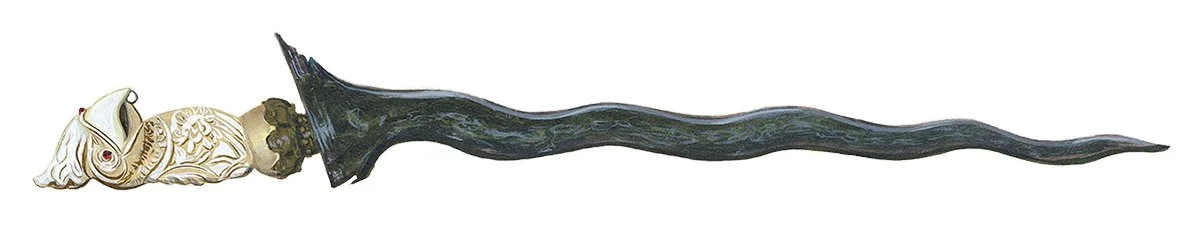
In my painting, I set aside the maternal interpretations of the ostrich and any imagery of it burying its head in the sand. Instead, I focused on the bird’s harder qualities, which inspired Shakespeare: its endurance, appetite, and ferocity. I depict two male ostriches locked in combat and surrounded by stones and a dagger, a reference to their mythical diet of rocks and iron.
I deliberately chose a wavy-bladed dagger, whose curves mimic the movement of the ostrich’s diaphanous feathers. Wavy daggers are associated with Southeast Asia and the broader Islamic world, recalling the distant geographies through which Europeans encountered and imagined the ostrich. The dagger depicted in my painting comes from Perak, in present-day Malaysia, and was likely made between 1700 and 1800.[13]
Like so many of Shakespeare's birds, the ostrich occupies an uncertain space between observation and invention. Across centuries, the bird became a creature of contradictions. Rather than resolve those tensions, my painting embraces them and returns the ostrich to the strange, formidable place it occupies in Shakespeare’s world.
Endnotes
[1] Phipson, Emma. Animal Lore of Shakespeare's Time, Facsimile ed., Glastonbury: The Lost Library, 1883, p. 294.
[2] Oxford English Dictionary, s.v. “estriche (n.),” Oxford University Press, accessed 28 June 2026, Oxford English Dictionary
[3] Oxford English Dictionary, s.v. “ostrich (n.),” Oxford University Press, accessed 28 June 2026, Oxford English Dictionary
[4] Pliny the Elder, The Natural History, trans. John Bostock and H. T. Riley, vol. II (London: Henry G. Bohn, 1855), Book X, ch. 1, Project Gutenberg eBook no. 60230, accessed 28 June 2026, Project Gutenberg
[5] Herman Melville, Moby-Dick; or, The Whale (New York: Harper & Brothers, 1851), ch. 49, ‘The Hyena’, first paragraph.
[6] Jen Datiles, ‘Myths in the Museum: The Iron-Eater and the Ostrich Egg’, UCL Researchers in Museums (blog), 4 July 2019, accessed 28 June 2026, UCL Researchers in Museums
[7]U.S. National Park Service, “Captain John Smith,” Historic Jamestowne, Colonial National Historical Park, accessed 29 June 2026, https://www.nps.gov/jame/learn/historyculture/life-of-john-smith.htm.
[8] Phipson, Emma. Animal Lore of Shakespeare's Time, Facsimile ed., Glastonbury: The Lost Library, 1883, p. 294.
[9] John Leo [Leo Africanus], in Samuel Purchas (ed.), Hakluytus Posthumus, or Purchas his Pilgrimes, vol. II (London: William Stansby for Henrie Fetherstone, 1625), p. 849.
[10] The Holy Bible, Conteyning the Old Testament, and the New, King James Version, 1611 facsimile edn (Nashville, TN: Thomas Nelson, 1982), Job 39:13–17.
[11] Frankenscience, ‘Why Ostriches Raise Other Females’ Chicks’ (YouTube video, 27 August 2021) https://www.youtube.com/watch?v=oF0l8sAaGiI [accessed 29 June 2026].
[12] Frankenscience, ‘Why Ostriches Raise Other Females’ Chicks’ (YouTube video, 27 August 2021) https://www.youtube.com/watch?v=oF0l8sAaGiI [accessed 29 June 2026].
[13] Victoria and Albert Museum, Dagger and Sheath, Perak (Malaysia), c. 1700–1800, steel, wood and metal fittings, museum no. O451218, V&A Collections.