Peacock (Pavo cristatus)
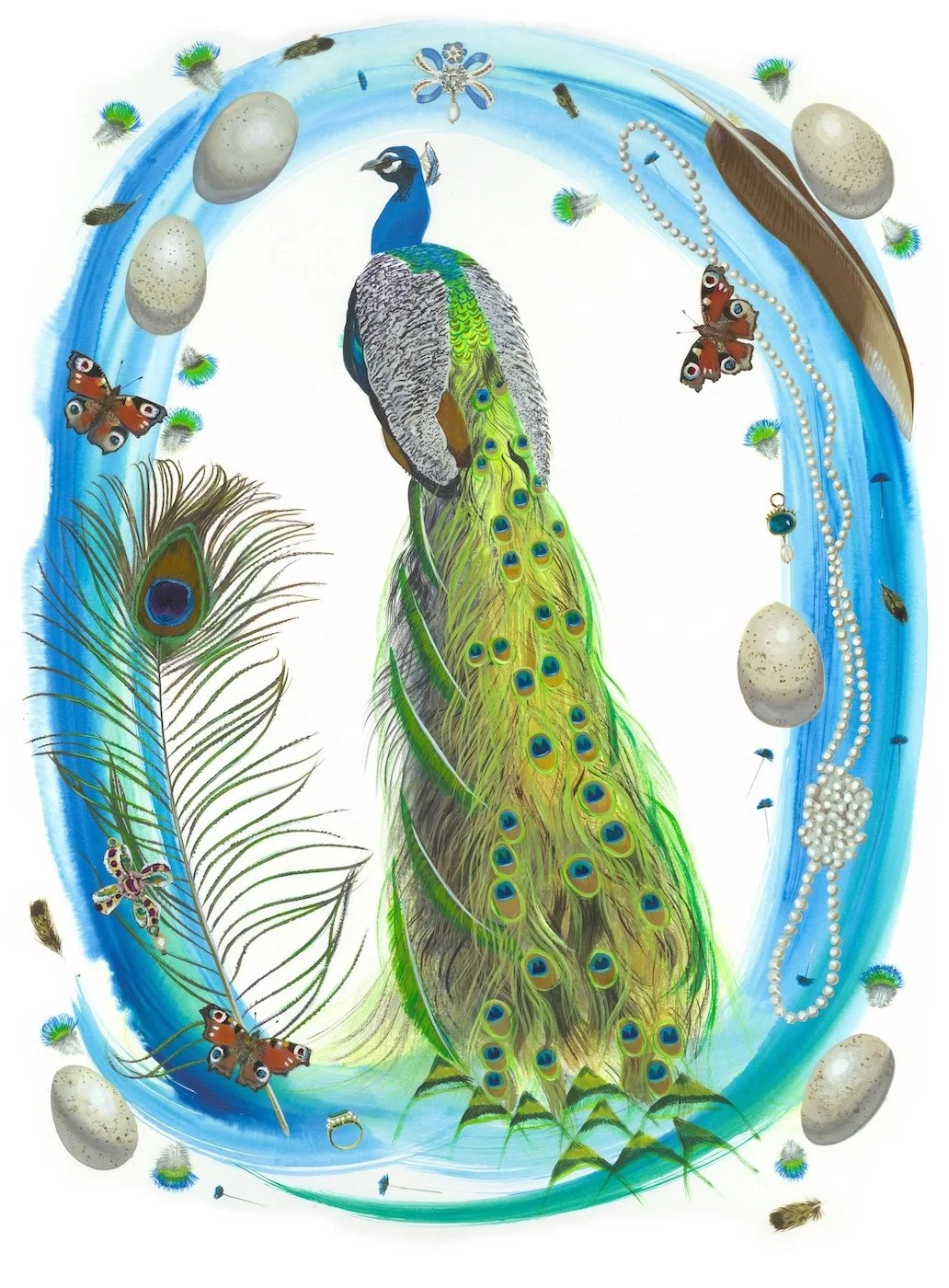
Peacock (Pavo cristatus) by Missy Dunaway, 30x22 inches, acrylic ink on paper
Painting Key
Fauna: 1 male Indian peafowl (Pavo cristatus), 3 peacock butterflies
Objects: 6 Indian peafowl eggs, 28 Indian peafowl feathers, 3 pendants, 1 string of pearls, 1 ring.
Shakespeare’s Peacock
Occurrences in text: 6
Plays: The Comedy of Errors, Hamlet, Henry V, Henry VI Part 1, The Tempest, Troilus and Cressida
Name as it appears in the text: “peacock,” “pea-cock,” “pajock” “cock”
The Peacock’s Plumes
In choosing a bird to represent royalty, beauty, pride, and vanity, Shakespeare rightly chose the male peafowl, commonly called the peacock. The peacock is not native to the British Isles, but it was a familiar domestic bird in early modern England. The blue Indian peafowl is native to India and Sri Lanka, but was imported to England by Sir John Foxley in the 14th century, and continued to filter into the country as gifts exchanged between royalty, or to embellish the lawns of noble estates.[1]
Peafowl belong to the order Galliformes, which includes chickens, pheasants, and quail. They are among the largest birds that can fly, although their flying is limited.[2] The peacock’s most celebrated feature is not technically his tail, but a cascade of elongated coverts that grow from his back. These feathers can reach five feet in length and number as many as two hundred.[3] Each plume is marked with a large eyespot, or ocellus. The bird lifts the shorter tail feathers beneath these coverts to prop them up and create the familiar fan.
At first glance, the peacock’s tail appears maladaptive. The train requires immense energy to produce, attracts predators, and hinders movement. In 1860, Charles Darwin wrote in a private letter to Asa Gray, “The sight of a feather in a peacock’s tail, whenever I gaze at it, makes me sick!”[4] The bird’s beauty troubled him because it seemed to contradict his developing theory of natural selection. Later research, however, suggests that peahens prefer males with prominent eye-marked feathers, which may explain why such extravagant plumage persists despite its costs.[5]
The peacock’s paradoxical plumage ultimately helped Darwin articulate the theory of sexual selection, in which aesthetic preference can drive evolutionary change. This idea later informed Ronald Fisher’s early twentieth-century model of the Fisherian runaway mechanism, in which exaggerated traits and mate preference reinforce one another across generations. The dramatic sexual dimorphism between the flamboyant male peacock and the drab female peahen remains one of the most familiar examples of this process.[6]
Juno’s Bird
Long before Darwin puzzled over the peacock’s tail, the bird occupied a prominent place in classical mythology. Many of Shakespeare’s birds are associated with Roman gods. Venus’s chariot is drawn by turtle doves and Jupiter rides on the back of a golden eagle. Other birds enter the tradition through tales of metamorphosis. The Greek mythology figures of Philomel and Halcyone are transformed into the nightingale and kingfisher, respectively.
The peacock is companion to Juno, the wife of Jupiter and queen of the Roman gods. In The Tempest, Iris, the rainbow goddess and messenger of the gods, summons the classical deities of Ceres and Juno to celebrate and bless the union of Ferdinand and Miranda. Juno arrives attended by peacocks.
The Tempest, Act IV, Scene 1, Line 56
IRIS: Ceres, most bounteous lady, thy rich leas
Of wheat, rye, barley, vetches, oats, and peas;
Thy turfy mountains, where live nibbling sheep,
And flat meads thatched with stover, them to keep;
Thy banks with pionèd and twillèd brims,
Which spongy April at thy hest betrims
To make cold nymphs chaste crowns; and thy
broom groves,
Whose shadow the dismissèd bachelor loves,
Being lass-lorn; thy poll-clipped vineyard,
And thy sea marge, sterile and rocky hard,
Where thou thyself dost air—the Queen o’ th’ sky,
Whose wat’ry arch and messenger am I,
Bids thee leave these, and with her sovereign grace,
Here on this grass-plot, in this very place,To come and sport. ⌜Her⌝ peacocks fly amain.
Approach, rich Ceres, her to entertain.
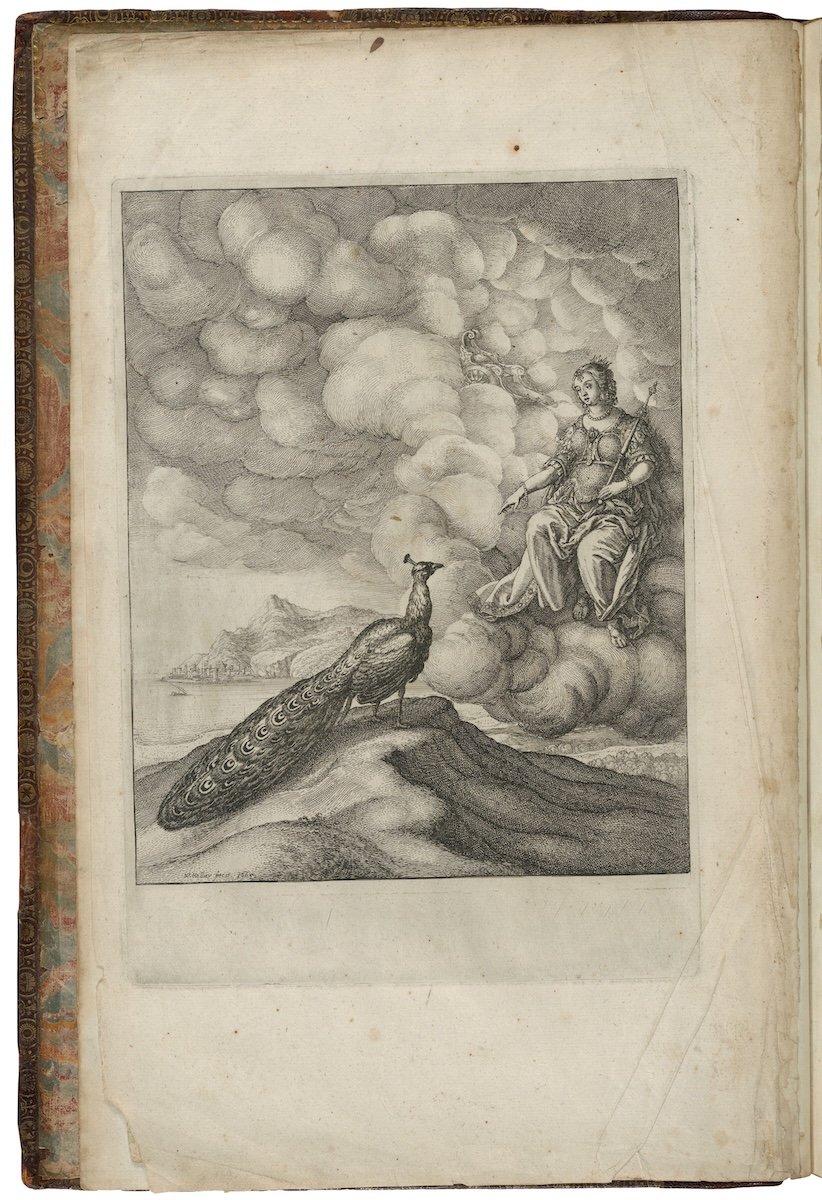
The peacock complains to Juno that it wants a beautiful singing voice, like the nightingale. Illustration by John Ogilby, 1668. Folger Shakespeare Library
The peacock is the titular character in five of Aesop’s fables: Juno and the Peacock, The Jay and the Peacock, The Peacock and the Nightingale, The Peacock and the Pie, and The Crane and the Peacock. In Juno and the Peacock, the bird complains to Juno that its voice is harsh and unattractive, and envies the nightingale’s beautiful song. Juno encourages the bird to be grateful for the gifts it possesses. She expects that if the peacock were granted a beautiful voice in addition to its splendid form, it would soon discover some new cause for dissatisfaction. Through the peacock’s complaint, the fable reminds readers to value their own gifts and avoid coveting those of others, as envy is insatiable and leads to greed.
The Peacock’s Lesson for Kings
The peacock’s complaints to Juno are valid, though, because it is rarely celebrated for other virtues. Throughout Aesop’s Fables, the peacock serves as a symbol of outward beauty unsupported by deeper virtues. This stands in contrast to the eagle, another bird that represents royalty, but also embodies strength, leadership, and skill.[7] The peacock’s beauty masks weakness, serving as a powerful visual reminder to kings not to rely on ceremony to establish worth. Across Shakespeare’s plays, the peacock exclusively appears in the third or fourth acts, in moments of excess, performance, or impending downfall. The bird that best represents royalty also suggests that too much display may precede a fall.
These moral associations with the peacock are echoed in Francis Bacon’s 1613 essay “Of Followers and Friends,” where he writes, “Costly followers are not to be liked, lest while a man maketh his traine longer, hee make his Wings shorter.”[8] Bacon’s use of the word “traine” functions as a double entendre. In the immediate context, it refers to the retinue of attendants that accompanies a powerful man. The image also recalls the peacock’s train of feathers. Bacon warns that a large entourage may display status, but it ultimately diminishes practical power, just as the peacock’s magnificent train hinders its ability to fly.
Closely related to vanity, the peacock also serves as a symbol of pride. In Hamlet, we encounter an alternate spelling of the bird as “pajock,” which scholars agree is a peacock, an emblem of the sin of pride.[11] In Act 3, after arranging the performance of a play that mirrors the murder of his father, Hamlet is delighted to see King Claudius react with visible distress, which he interprets as a sign of guilt. Feigning madness, Hamlet breaks into song and deliberately substitutes the word “pajock” for “ass,” the word that would have completed the rhyme. By invoking the peacock, Hamlet sharpens the satire of the song and alludes to the pride that surrounds the corrupt court.
Hamlet, Act III, Scene 2, Line 297
HAMLET: Why, let the strucken deer go weep,
The hart ungallèd play.
For some must watch, while some must sleep:
Thus runs the world away.
Would not this, sir, and a forest of feathers (if the
rest of my fortunes turn Turk with me) with two
Provincial roses on my razed shoes, get me a
fellowship in a cry of players?HORATIO Half a share.
HAMLET A whole one, I.
For thou dost know, O Damon dear,
This realm dismantled was
Of Jove himself, and now reigns here
A very very—pajock.HORATIO You might have rhymed.
In emblematic imagery, Cupid is sometimes shown stepping on a peacock’s train, insulting its pride, just as Cupid figuratively humbles lovers through rejection or unrequited desire. Shakespeare draws upon this association, threatening the peacock’s feathers in moments meant to embarrass or emasculate. In Henry VI, Part 1, Joan of Arc, also called Purcelle, describes the proud Talbot sweeping along “like a peacock,” promising that his enemies will “pull his plumes and take away his train.”
Henry VI Part 1, Act III, Scene 3, Line 1
PUCELLE: Dismay not, princes, at this accident,
Nor grieve that Roan is so recoverèd.
Care is no cure, but rather corrosive
For things that are not to be remedied.
Let frantic Talbot triumph for a while,
And like a peacock sweep along his tail;
We’ll pull his plumes and take away his train,
If dauphin and the rest will be but ruled.
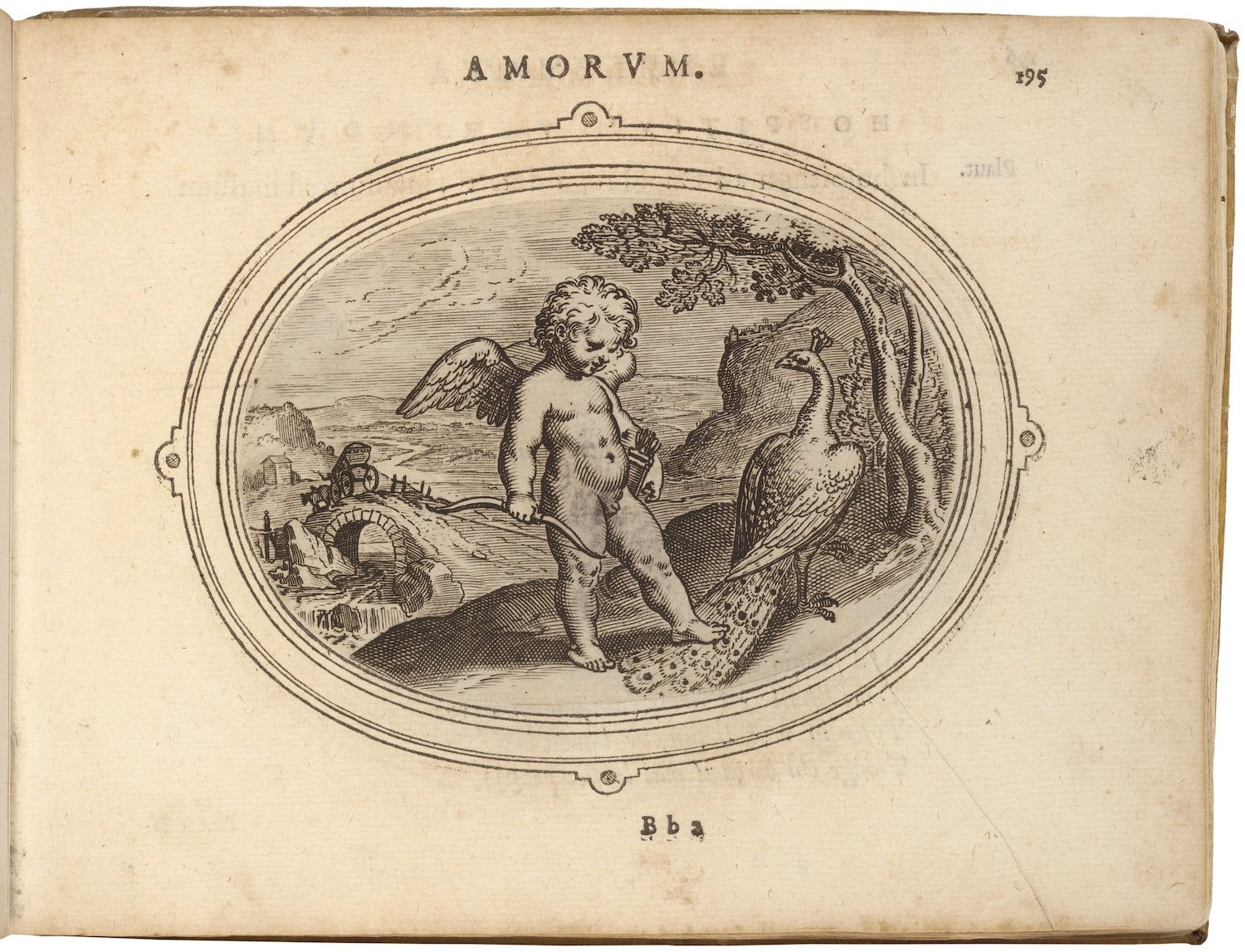
The peacock is often mocked and insulted in Shakespeare’s plays and other fables. Illustration by Otto Van Veen, 1608. Folger Shakespeare Library
In Henry V, the common soldier Williams speaks with King Henry on the eve of the Battle of Agincourt. The king is disguised as an ordinary soldier, and Williams does not realize whom he is addressing. Skeptical that the king will fight alongside his men, Williams dismisses the idea that a private soldier could ever hold a monarch accountable. Attempting to challenge a king, he says, would be like trying “to turn the sun to ice with fanning in his face with a peacock’s feather.” The beautiful peacock’s feather is rendered absurdly delicate when given a functional use. It cannot cool the sun any more than a private man can challenge a monarch.
Henry V, Act IV, Scene 1, Line 197
KING HENRY (in disguise): I myself heard the King say he would not
be ransomed.WILLIAMS: Ay, he said so to make us fight cheerfully,
but when our throats are cut, he may be ransomed
and we ne’er the wiser.KING HENRY: If I live to see it, I will never trust his
word after.WILLIAMS: You pay him then. That’s a perilous shot out
of an elder gun, that a poor and a private displeasure
can do against a monarch. You may as well go
about to turn the sun to ice with fanning in his face
with a peacock’s feather. You’ll “never trust his
word after.” Come, ’tis a foolish saying.
For all its splendor, the peacock was also eaten. Medieval and early modern royal banquets sometimes featured a roasted peacock presented with a gilded beak.[9] Knights swore vows upon the bird before feasts, which lead to the common swear, “by cock and pie,” which likely refers to the peacock and the magpie. To swear upon the peacock was to align oneself with nobility. To swear upon the magpie was to make an oath to common people.[10] The phrase shows up as a casual idiom in Hamlet, Henry IV Part 2, and The Merry Wives of Windsor.
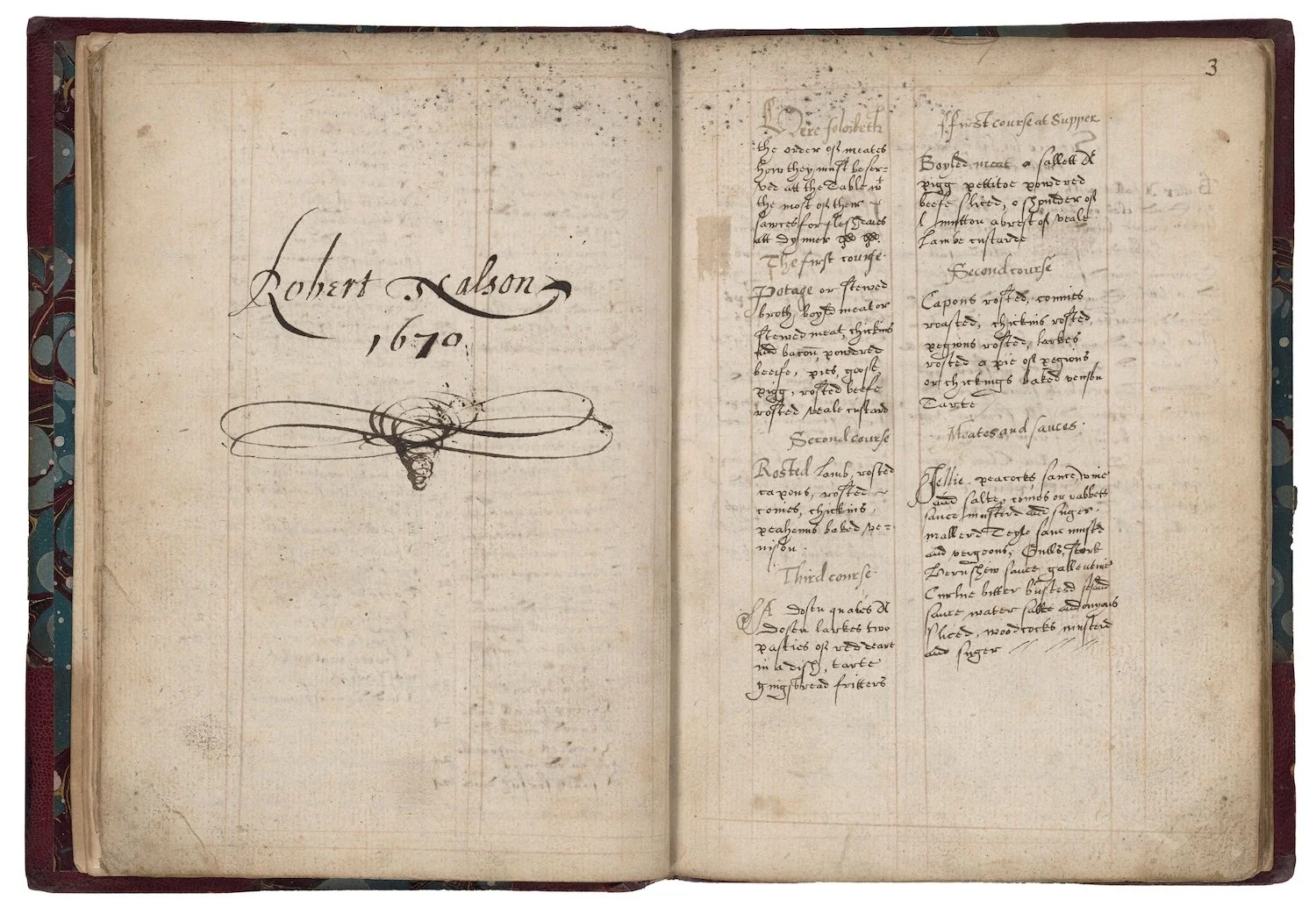
This cookbook from 1650 written by Nicholas Webster instructs readers to serve “rosted peahenns” in the second course of a meal. Folger Shakespeare Library
Behind the Painting
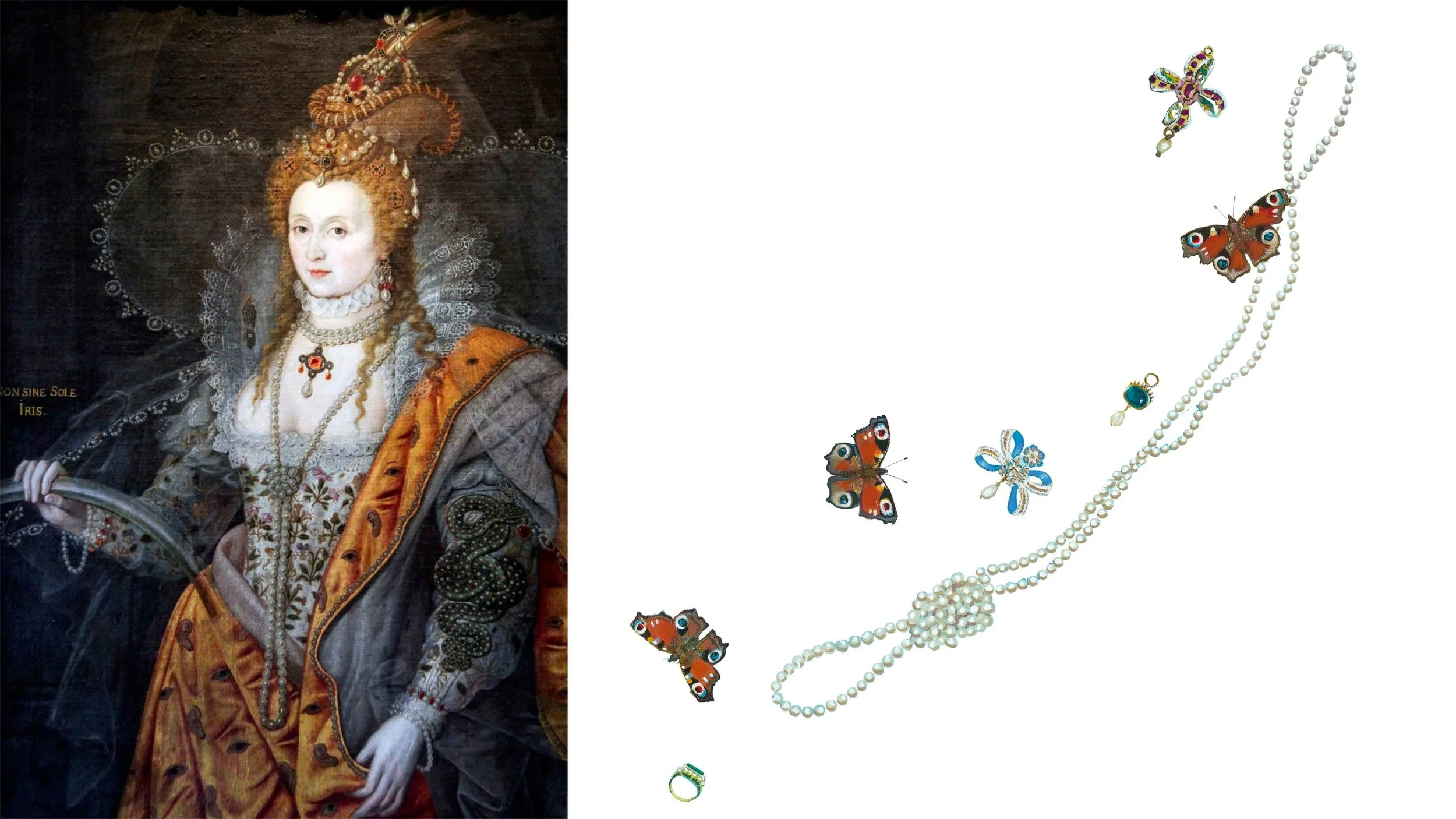
In my painting, I chose to render only the male peacock, which is the bird we meet in Shakespeare’s plays. The painting is dotted with three peacock butterflies, one of the most common butterflies in England. To evoke the peacock’s associations with royalty, I surrounded it with examples of seventeenth-century English royal jewelry, including a long string of pearls famously worn by Queen Elizabeth I in The Rainbow Portrait. Elizabeth, known as the Virgin Queen, was especially fond of wearing pearls, as they were symbols of purity and virginity. She reigned during fourteen years of Shakespeare’s career as a playwright.
Endnotes
[1] “When Were Peacocks Introduced to the UK?” Peacocks UK. Accessed March 7, 2026. https://www.peacocksuk.com/when-were-peacocks-introduced-to-the-uk/
[2] “Peacock.” Encyclopaedia Britannica. Accessed March 7, 2026. https://www.britannica.com/animal/peacock
[3] “Indian Peafowl.” National Geographic Kids. Accessed March 7, 2026. https://kids.nationalgeographic.com/animals/birds/facts/indian-peafowl
[4] Darwin, Charles. Letter to Asa Gray, April 3, 1860. Darwin Correspondence Project, Letter no. 2743. https://www.darwinproject.ac.uk/letter/?docId=letters/DCP-LETT-2743.xml
[5] Arnold, Carrie. “Mystery Solved: Why Peacocks Got Their Eyespots.” National Geographic, July 15, 2014. https://www.nationalgeographic.com/animals/article/peacocks-tails-eyespots-feathers
[6] Dakin, Roz, and Robert Montgomerie. “Peacock Eyespots and Female Choice.” Proceedings of the Royal Society B: Biological Sciences. https://pmc.ncbi.nlm.nih.gov/articles/PMC2987134/
[7] Harting, James Edmund. The Birds of Shakespeare. London: John Van Voorst, Paternoster Row, 1871. Project Gutenberg. https://www.gutenberg.org/ebooks/41860
[8] Bacon, Francis. Bacon’s Essays, and Wisdom of the Ancients. London: 1625. Project Gutenberg edition. https://www.gutenberg.org/files/56463/56463-h/56463-h.htm
[9] Harting, James Edmund. The Birds of Shakespeare. London: John Van Voorst, Paternoster Row, 1871. Project Gutenberg. https://www.gutenberg.org/ebooks/41860
[10] Harting, James Edmund. The Birds of Shakespeare. London: John Van Voorst, Paternoster Row, 1871. Project Gutenberg. https://www.gutenberg.org/ebooks/41860
[11] Shakespeare, William. The Tragedy of Hamlet, Prince of Denmark. The Norton Anthology. 2nd ed. Eds. Greenblatt, Stephen, Walter Cohen, Jean E. Howard, and Katherine Eisaman Maus. New York: W.W Norton, 2008. 1742. Print.